To turn your website into a salesperson, you must replace static text with an interactive lead-capture system, automated follow-up workflows, and a conversion-focused user experience. It shifts your digital presence from a passive brochure that waits to be read into an active engine that identifies, qualifies, and captures buyers 24/7. While a human salesperson works specific office hours and requires sleep, an engineered website operates continuously, systematically guiding cold traffic through a structural funnel: hooking their attention, explaining your exact value proposition, and closing them with an actionable call to action (CTA).
In 2026, simply “having a website” is no longer a competitive advantage. If your site does not actively engage, qualify, and route leads into your sales pipeline automatically, it is costing you revenue. Here is exactly how to engineer your website into your company’s top-performing, 24/7 sales representative.
The Architecture: Anatomy of a Digital Closer
A traditional website functions like a poster—it looks nice but does nothing when a customer interacts with it. A high-converting website functions like an elite consultant. It guides a user through a deliberate psychological journey designed to convert awareness into immediate action.
The First 5 Seconds: The High-Intent Hero Section
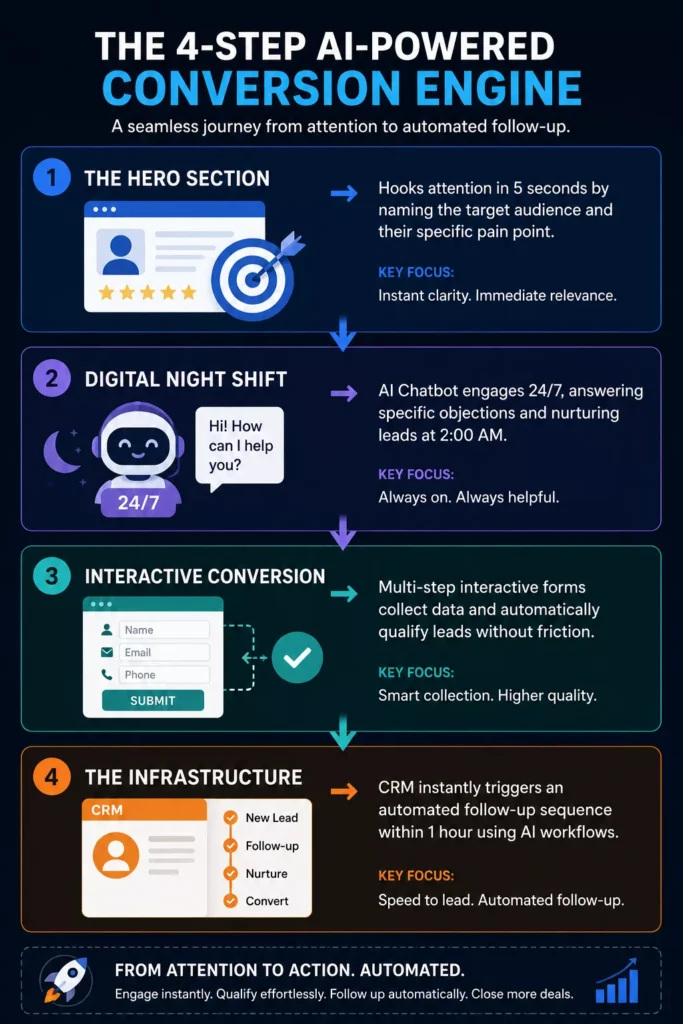
A human salesperson has a brief window to make a strong first impression; your website has exactly five seconds. When a visitor lands on your homepage, they must immediately understand what you offer and how you solve their exact problem. If your headline is vague or generic, the user will hit the back button.
Your hero section needs to target your specific audience’s pain points directly. When we designed the digital portal for Mariland Lending, a local financial lending institution, we didn’t use generic corporate taglines. Instead, the hero section broadcasted a direct, supportive message: “A helpful hand for teachers and vendors.”
By speaking directly to their exact target demographic and placing an accessible, interactive application interface right beside that hook, we answered the user’s immediate question—“Can this company help me?”—before they even had to scroll.
Case Study: Eliminating Paper Friction for Mariland Lending
Real-World Application: From Tedious Manual Entry to a Automated Lead Funnel
- The Hidden Friction: Mariland Lending originally relied on a highly manual application pipeline. Staff had to manually send out files, and customers had to download, fill out, and return dense physical forms. This multi-step process created massive friction, causing qualified applicants to drop out of the funnel due to sheer administrative fatigue.
- Our Intervention: Modern Chameleon transformed their website from a static informational landing page into an automated financial salesperson. We built a customized, step-by-step digital application funnel directly into the core website architecture.
- The Quantifiable Result: Prospective clients can now navigate a streamlined, interactive application journey online. The website captures their intent, qualifies their background, and instantly routes the clean lead data directly to Mariland’s internal sales team. The administrative bottleneck was completely bypassed by the system.
The Interactive Qualification Engine
Long, traditional contact forms with fifteen empty boxes to fill out are conversion killers. They overwhelm users and feel like homework. To combat this, your digital salesperson needs to utilize multi-step interactive forms.
By breaking down the data collection process into logical, bite-sized steps, users can easily move through the workflow without feeling fatigued. During our development discovery with Mariland, we mapped out their exact internal loan processing mechanics. We then mirrored that logic into a conversational user interface that saves progress in real time.
If an applicant gets distracted and steps away, their data remains securely saved. They can return later and pick up exactly where they left off without the hassle of re-entering information. Once completed, the structured profile lands directly in the hands of a client relations representative.
The 2:00 AM Night Shift: AI Chatbot Integration
Your human team cannot work around the clock, but your customers browse at all hours of the night. Integrating a smart AI-powered chatbot into your website ensures you have a trained customer service representative operating 24/7.
This isn’t the rigid, frustrating chat menu of the past. Modern AI assistants are fully trained on your specific services, product catalogs, pricing structures, and operational boundaries. When a prospect asks a nuanced question at 2:00 AM, the AI instantly provides an accurate, conversational response, addresses their objections, and guides them toward booking a call or submitting a form. It turns passive late-night browsing into a structured, nurtured lead before your team even opens their laptops in the morning.
Automated Follow-Ups: The CRM Handoff
A salesperson who waits three days to respond to an inquiry loses the deal. Speed-to-lead is the single most critical factor in modern digital conversions. The moment a prospect submits their information on your website, a backend automated sequence must trigger instantly.
Through advanced CRM (Customer Relationship Management) integration, your website serves as the entry point for automated workflows. Within an hour of a lead inputting their data, the system automatically dispatches a personalized email or message using smart AI logic. This follow-up acknowledges their unique inquiry and outlines the immediate next steps needed to advance their loan or service request. By automating this initial touchpoint, you strike while the consumer’s intent is at its highest, keeping your brand top-of-mind.
Trust Engineering for High-Ticket Conversions
If your business handles sensitive transactions, financial information, or high-ticket purchases (such as Mariland’s lending applications or Consuelo Del Triste’s funeral services), your digital salesperson must project absolute security and credibility.
Cold visitors will not input personal or financial data unless your interface actively establishes trust. We achieve this through strategic trust engineering:
- Explicit Security Sign-offs: Visually placing clear indicators like “Your data is safe with us” or data privacy badges directly beneath input fields reassures users that their personal information is protected.
- Compliant Legal Frameworks: Displaying clearly articulated Privacy Policy and Terms & Conditions pages reinforces your legitimacy.
- Dynamic Social Proof Placement: Embedding dedicated review and testimonial sections allows prospective clients to see the exact volume of successful transactions and real-world clients your business has already served.
Core Performance: Speed and Mobile UI/UX
If a human salesperson is slow, cluttered, or difficult to understand, the customer will simply walk out of the store. The exact same rule applies to your website performance.
| Performance Metric | The Impact on Conversions | The Revenue Risk |
| Fast Loading Speed | Retains high-intent users; smooth navigation. | Slow loading causes users to bounce to competitors. |
| Clean Mobile UI/UX | Ensures clear readability and frictionless forms on phones. | Cluttered layouts confuse users, killing conversion rates. |
| Data Continuity | Saves form inputs dynamically in real time. | Forcing users to retype data causes immediate drop-offs. |
A laggy desktop layout or an unoptimized, cluttered mobile interface will destroy your conversion rates. Your site must be engineered for fast loading speeds and flawless mobile responsiveness to ensure your digital storefront remains accessible and frictionless.
The Ultimate Argument: Website vs. Facebook Page
A common question from local business owners is: “My Facebook page generates inquiries for free, so why do I need to invest in a premium, custom website?”
Think of it as the difference between renting a small stall in a crowded public market versus owning a permanent, multi-branch flagship store. While a Facebook page is a useful tool for generating early social traction, it binds you to a chaotic, crowded platform where your competitors are always just a click away.
Leveraging a custom website gives you a powerful long-term advantage:
- Google Map & Search Dominance: A Facebook page rarely secures the absolute top organic spots on Google search. An optimized website positions your brand at the very top of high-intent search results, capturing users who are actively looking to buy right now.
- Asset Accumulation: A custom website functions like opening a second digital branch that captures a completely separate, higher-value target audience.
- Zero Platform Dependency: You own the code, the user data, and the interactive funnels. Your digital salesperson belongs completely to you, building equity and value for your company over time.
Managing the Metric Timeline: What to Track
When Modern Chameleon deploys an automated, high-converting website, success is measured through a structured timeline of performance data:
- Months 1 to 3 (The Velocity Phase): The initial 90 days focus on optimization and search engine discovery. The primary metric to track here is your Google Search Console impression volume. We focus on driving that trajectory upward, ensuring your digital footprint is expanding and indexing correctly.
- Months 4 to 6 (The Conversion Horizon): Once the data and visibility are established, those impressions translate into active clicks, and those clicks convert directly into automated inquiries and sales. This is where the long-term compounding ROI of your digital salesperson truly begins to reflect in your bottom line.
Frequently Asked Questions (FAQ)
What happens if a user abandons a multi-step form halfway through?
Our custom system architectures save data inputs dynamically. If a user drops off, their information is securely captured by your CRM, allowing your sales team or an automated follow-up sequence to reach out and help them complete the process.
Is an AI chatbot difficult for my existing team to manage?
Not at all. The AI chatbot operates autonomously based on pre-programmed business rules, service data, and FAQ schemas. It acts as an independent customer service rep, only handing off complex cases to your staff when a lead is fully qualified and ready for a human closer.
How does an optimized website help our real-world sales team?
It acts as a filter. Instead of your sales staff spending hours manually answering basic questions, repeating pricing rules, or chasing unqualified leads, the website handles the repetitive filtering. Your team receives warm, pre-qualified leads who are already educated on your services and ready to do business.