When local business owners hear the word “marketing,” they often view it through the lens of a traditional expense money gone from the bank account, gone forever. If a campaign doesn’t yield immediate cash flow in week one, panic sets in.
But in 2026, digital marketing must be treated as a compounding financial asset. What you invest in today does not simply vanish when a campaign ends. It builds a permanent digital footprint that triggers a ripple effect of business growth for years to come.
If you want to stop guessing your numbers and start engineering predictable profit, you need to understand how Return on Investment (ROI) actually operates.
The 80% Rule and the Operational Marketing Timeline
Marketing ROI is rarely an overnight phenomenon; it matures across distinct phases. A healthy partnership with an agency relies on setting a realistic, data-driven threshold: the 80% Target Goal.
Whether tracking brand visibility or conversion metrics, a campaign is considered successful when it hitting at least 80% of its forecasted milestone for that specific month.
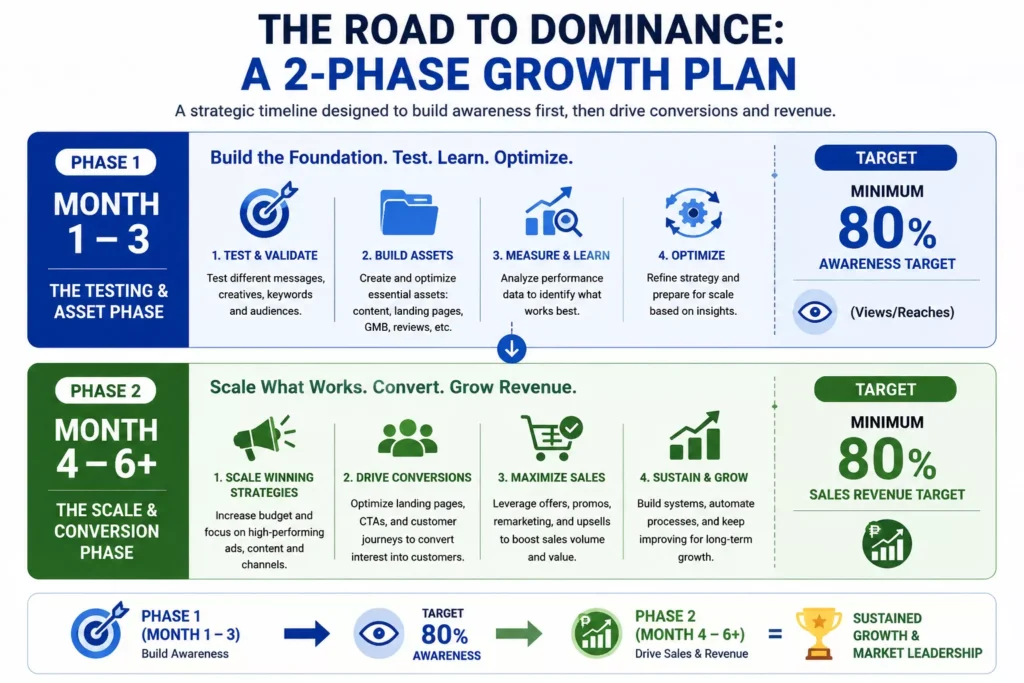
- Months 1 to 3 (The Setup & Momentum Window): Your capital pays for foundational design assets, market testing, data collection, and visibility. The primary metric here is brand equity and audience attention. If your budget is ₱10,000 for an awareness push, hitting your 80% target means securing roughly 400,000 to 500,000 active views.
- Months 4 to 6 and Beyond (The Exponential Horizon): This is where top-of-funnel traction converts into real bottom-line profits. The data gathered during testing is optimized to hit your sales goals consistently.
The most vital shift is understanding that even a standard 6-month marketing push stays indexed online permanently. A blog or an optimized asset built today will continue driving inbound traffic 12 to 24 months down the road, lowering your long-term customer acquisition costs.
Escaping the Vanity Metric Trap
Many business owners celebrate generating 1,000 new Facebook page likes or a spike in video views. While these spikes look impressive on a report and serve a purpose for early brand validation, they are ultimately vanity metrics if they do not lead to financial returns.
The metric itself isn’t fake—building a viral presence is excellent for consumer trust. However, the trap occurs when a business focuses on superficial engagement while ignoring the bottom line. If your digital footprint is expanding but your sales remain completely flat after 4 to 6 months of active campaigning, your marketing funnel is broken. True ROI requires a defined path that converts attention into revenue.
High-Ticket vs. Low-Ticket ROI Frameworks
You cannot measure a viral food brand using the same mathematical model as a specialized service provider. The financial scale of your product dictates your target metrics.
The Low-Ticket, High-Volume Framework
- Real-World Example: CraveBuwad, a local brand selling premium dried fish packs priced between ₱100 and ₱500.
- The Strategy: Because the unit economics are smaller, the ceiling for direct ad return is tighter. Hitting a realistic 2x to 3x ROI on ad spend is considered a healthy baseline. Growth here depends on volume, brand loyalty, and recurring orders.
The High-Ticket, Low-Volume Framework
- Real-World Example: Consuelo Del Triste, a premier funeral caskets and deathcare services provider where packages scale from ₱30,000 to ₱200,000.
- The Strategy: High-ticket service industries require highly targeted lead qualification rather than generic views. Because a single conversion carries immense value, an optimized campaign can yield a staggering 20x to 100x ROI relative to the direct advertising budget.
Direct Performance vs. Long-Term Organic Value
The Short-Term Ads Breakthrough: 6 Million Sales in 3 Months
In premium, high-ceiling niches like the real estate industry, optimized ad spend yields clean data. For one of our real estate campaigns, we deployed a lean budget of just ₱5,000 per month on Facebook Ads. By hyper-targeting qualified investors looking for premium properties, that single micro-budget helped close ₱6,000,000 in total sales within 90 days. While real estate is a distinct niche with massive transactional values, it proves that targeted media buying outperforms massive, unoptimized spending.
The Long-Term Organic Compounding: 100+ Hot Leads
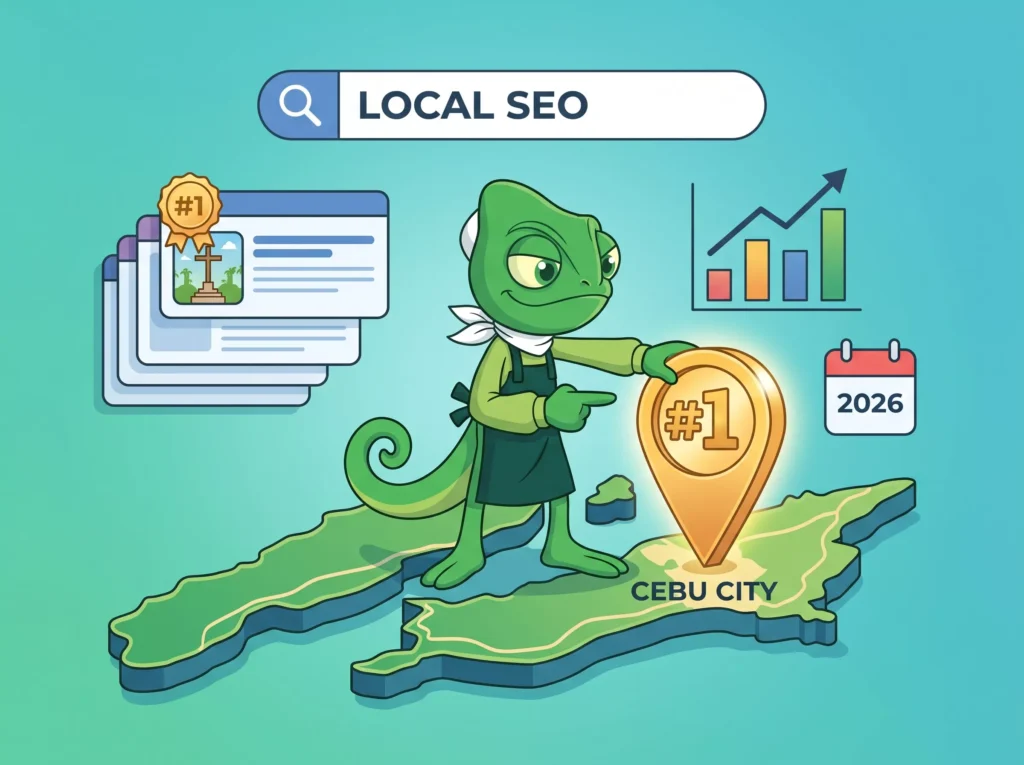
When we onboarded Consuelo Del Triste, they had zero digital presence. Rather than relying solely on paid ads, we engineered a comprehensive digital foundation: a custom, fully optimized website and a localized search engine optimization strategy.
During the first 90 days, the investment seemed quiet—the brand-new site was busy gaining authority with search engines, producing few initial inquiries. But by months 4 through 6, the organic engine kicked in. The website began generating over 100 hot, high-intent inquiries from families actively seeking services. This organic traffic required no ongoing daily ad budget, demonstrating how a patient digital investment builds a self-sustaining asset.
Internal Operational ROI: The Value of Time and Systems
True business evaluation looks beyond external marketing to measure internal efficiency. Investing capital into custom internal software, custom applications, or automated payment processing tools generates direct cost-saving returns.
When you develop internal automation (such as a unified CRM or automated invoicing workflows), your return is calculated through three operational pillars:
- Time Reclaimed: Your team bypasses tedious data entry and administrative clutter, freeing up hundreds of operational hours to focus on high-value client relations.
- Error Elimination: Manual data management frequently causes dropped leads, delayed invoices, and lost documentation. Automation eliminates human data leaks that silently drain your profits.
- Scalable Structure: Systems allow an organization to manage twice as many clients without needing to double its administrative headcount.
Spotting the Red Flags: When is ROI Truly Negative?
If your marketing partner presents beautiful engagement slide decks while your business feels strained, watch out for these performance indicators:
- For Low-Ticket Brands: If your campaigns have run for 4 to 5 months and you cannot point to a distinct, measurable uptick in sales revenue, your campaign strategy is failing to convert attention into action.
- For High-Ticket Brands: If your lead pipeline fails to hit at least 80% of its target qualified inquiries during the initial 90 days, or if the system fails to hit its projected milestones as campaigns scale, it is a clear warning sign that your creative message or targeting parameters are misaligned.
Setting Expectations: Facing the “Testing Valley”
The greatest threat to a successful campaign is an impatient business owner cutting a strategy short right before it yields results. Any provider promising overnight miracles is offering a dangerous red flag.
Digital marketing requires an initial setup and testing phase. Your capital pays for creative assets, audience building, and real-time behavioral data analysis. View your agency relationship as a long-term infrastructure partnership. The data collected, pixel tracking deployed, and content published onto the internet remains your intellectual property permanently, continually working to bring in customers long after your initial investment.
Frequently Asked Questions (FAQ)
If I don’t see sales in the first month, does it mean my agency is doing a bad job? Not necessarily. If your campaign is in its first 30 to 90 days, success is measured by top-of-funnel tracking: ad traction, audience reach, and initial message volume. Cutting a campaign early because it hasn’t generated immediate sales kills the strategy before it has a chance to mature.
Why shouldn’t a low-ticket product expect a 100x return on ad spend? Low-ticket items (like a ₱200 product pack) have tighter profit margins per unit and rely on repeated purchases. Achieving a 100x return on a single transaction is mathematically unrealistic compared to high-ticket industries like real estate or luxury services, where one sale offsets months of ad spend.
What is the fastest way to turn a negative marketing ROI into a positive one? Audit your conversion path. If your ads are getting views but no sales, the issue isn’t the traffic—it’s your landing page, customer response time, or checkout process. Fixing the friction points where users drop off is the quickest way to unlock hidden revenue.